
Extreme desert dryness unlocks new carbon removal approach
Sequest will store agricultural residue in the desert – where there is too little moisture for it to decay – with a first facility targeting 1,000 tonnes of net carbon removal.
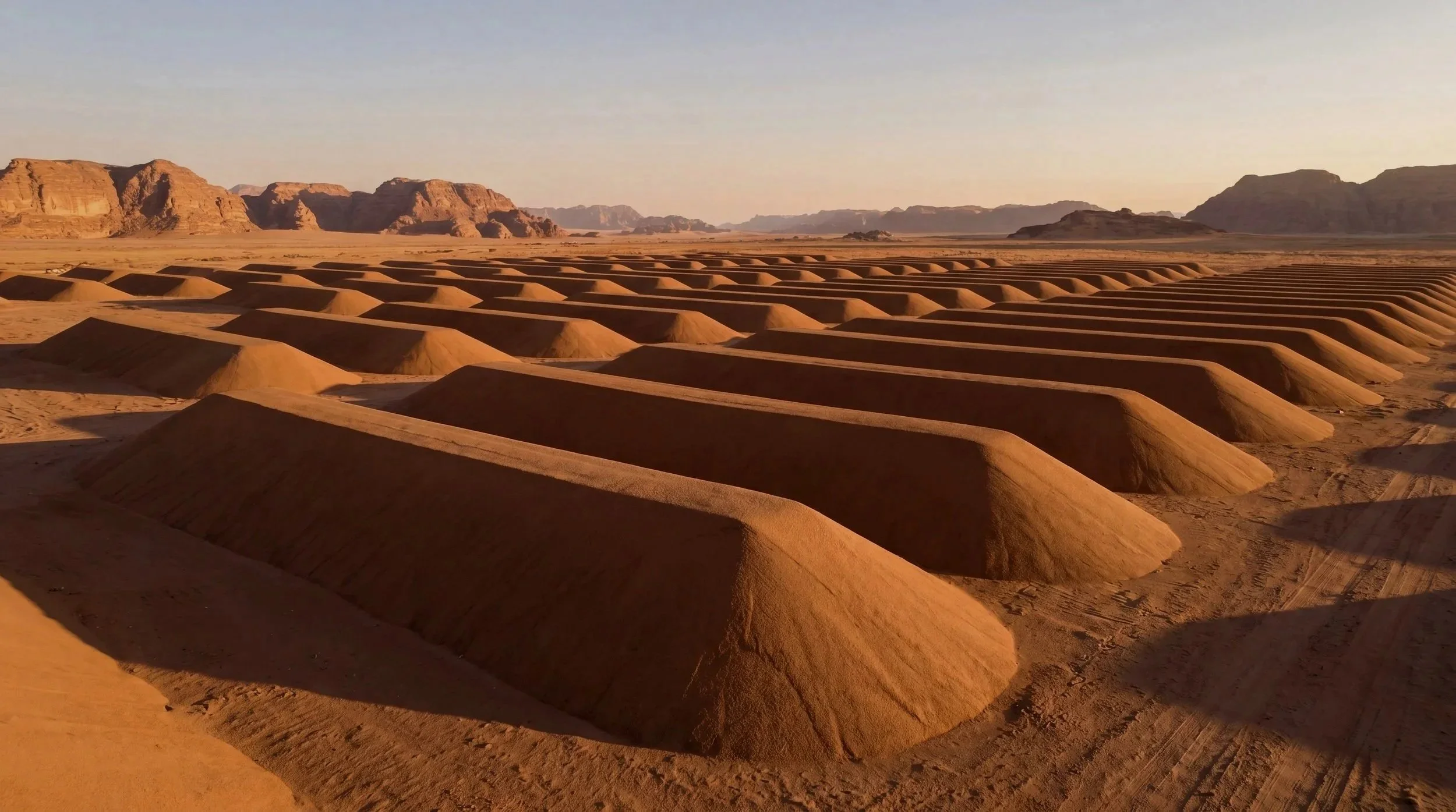
Rendering of Sequest’s desert carbon storage solution
10 AUGUST 2026 – Sequest today unveiled a carbon removal approach that uses the extreme dryness of deserts to stop agricultural residue from decaying, holding the carbon it contains out of the atmosphere. The approach has passed Preliminary Assessment by Puro.earth, a leading registry for durable carbon removal. The company's first commercial facility, Horizon, announced today, comes online in Saudi Arabia this year.
It arrives in a market that has struggled to fulfil its commitments. Buyers have secured roughly 49 million tonnes of durable carbon removal through long-term contracts. However, only about 1.6 million tonnes, or 3.3 percent, have been delivered, according to CDR.fyi.
“Carbon removal has a delivery problem. The climate does not benefit from a tonne contracted, only from a tonne delivered,” said Gary Ganz, chief executive and co-founder of Sequest.
Plants already remove carbon dioxide from the atmosphere through photosynthesis, at no cost. Agriculture produces over seven billion tonnes of crop residue a year as a by-product. Much of it is burned or left to rot, returning the captured carbon to the atmosphere. Sequest interrupts that cycle, taking suitable residue and storing it in engineered above-ground chambers in hyper-arid environments.
Biomass can survive for millennia in these conditions. For example, date palm, grain and linen have survived for thousands of years in Egypt's desert tombs because the air is too dry to support the microbes that cause decay. Sequest draws on the same principle. Agricultural residue that would otherwise be burned or left to rot, releasing its carbon, is instead stored in engineered chambers in hyper-arid desert environments. Low rainfall, low humidity and Sequest's patent-pending chamber system hold the material below the moisture level microbes need to break it down.
The system runs on biomass handling, trucking, earthworks and environmental monitoring. These are established industrial processes with known costs and existing vendors, and Sequest has field-tested the approach at its test facility. Because there is no new chemistry or energy-intensive processing to scale, the company expects to reach a low cost per tonne now rather than after years of working down a cost curve.
“We are defining hyper-arid biomass storage as a category the carbon market can count on,” said Ganz. “Extreme desert dryness does a lot of the preservation work, but it does not solve the whole problem. The hard part is keeping biomass intact, dry and auditable. Our patent-pending chamber system is designed to do exactly that.”
The company’s Horizon facility has an initial target of 1,000 tonnes of net carbon removal, roughly equivalent to the annual emissions of 500 cars in the UK. Sequest has partnerships in place with leading Saudi Arabian institutions covering land access for the facility and distribution of credits within the Kingdom. The company plans to expand capacity and international credit availability following issuance of its first credits.
ENDS